PPE — Personal Protective Equipment — is the single most critical line of defence in construction work. Across the UAE’s rapidly growing skyline, from Dubai’s mega-projects to Abu Dhabi’s infrastructure developments, wearing the right protective equipment is non-negotiable on every site.
Why PPE is essential in construction work
Construction work in the UAE operates at a scale and pace unlike anywhere else in the world. From high-rise towers in Downtown Dubai to vast industrial facilities in Sharjah and Ras Al Khaimah, workers face daily exposure to extreme heat, falling objects, hazardous substances, heavy machinery, and electrical risks. In this environment, proper use of PPE is not merely a best practice — it is a legal obligation enforced by federal and emirate-level authorities.
Beyond compliance, there is a clear human responsibility. Employers who provide high-quality PPE and enforce its use demonstrate that worker welfare is a genuine priority. This commitment reduces accidents, improves team morale, and prevents the costly delays that workplace injuries bring to construction work timelines across the country.
UAE regulations governing PPE on construction sites
Several key regulatory frameworks govern safety standards in UAE construction work:
UAE Federal Law No. 8 of 1980 — The foundational Labour Law requiring employers to provide safe working conditions and all necessary protective equipment at no cost to the worker.
OSHAD-SF (Abu Dhabi) — The Occupational Safety and Health Management System framework mandates risk assessments, PPE provision, and documented safety training for all Abu Dhabi construction sites.
Dubai Municipality Regulations — Enforces strict PPE compliance through regular site inspections, with penalties issued for non-conforming workers and contractors.
Ministry of Human Resources & Emiratisation (MOHRE) — Oversees worker welfare standards nationally, including heat protection protocols critical for UAE outdoor construction work.
Essential types of PPE for UAE construction sites
The right PPE must be matched to the specific hazards of each task and the unique conditions of the UAE climate. Here are the most critical categories required in construction work across the Emirates:
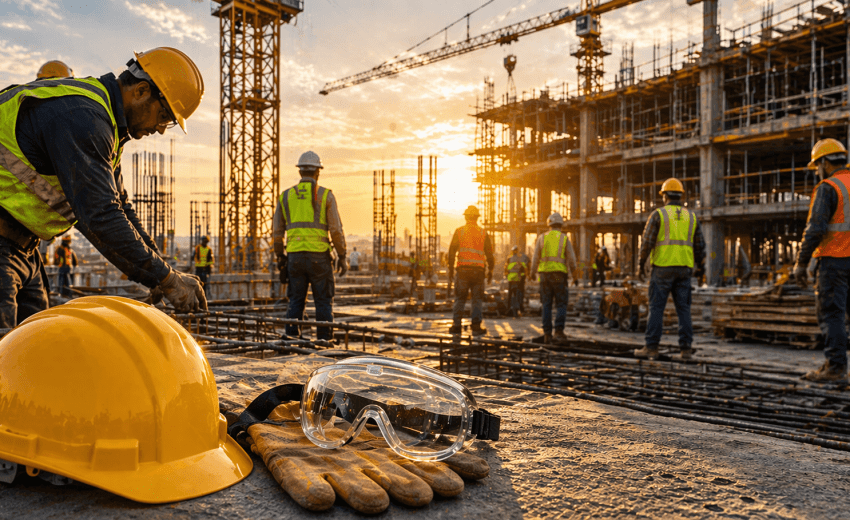
Hard Hats — Protects against falling objects and overhead impact. Mandatory on all active UAE construction zones.
Eye Protection — Safety goggles and face shields guard against dust, desert sand, debris, sparks, and chemical splash.
Protective Gloves — Essential when handling sharp materials, chemicals, or surfaces exposed to intense UAE heat.
Safety Boots — Steel-toed footwear prevents crush injuries and punctures across uneven construction terrain.
Hi-Vis Clothing — Keeps workers visible to vehicle and crane operators, especially during night shifts and low-visibility conditions.
Respiratory Protection — Masks and respirators protect against dust, silica, sandstorms, fumes, and chemical vapours common on UAE sites.
Heat protection — a UAE-specific priority
The UAE’s extreme summer temperatures — regularly exceeding 45°C — make heat stress one of the greatest risks in outdoor construction work. The UAE government enforces a mandatory midday work ban from 12:30 PM to 3:00 PM between June 15 and September 15 each year. Alongside this, employers must provide cooling PPE such as UV-protective clothing, cooling vests, and adequate shade structures. Hydration stations on every site are not optional — they are a legal requirement and a basic duty of care.
Common mistakes that put workers at risk
Providing PPE is only the first step — it must be worn correctly and consistently throughout all construction work activities. Frequent errors include using ill-fitting or expired equipment, failing to adapt PPE choices to changing site hazards, and removing protection during breaks in areas that remain dangerous.
Site supervisors and safety officers bear a direct responsibility here. Regular inspections, daily toolbox talks, and visible leadership from management ensure that safety equipment is actively used — not just available — across every UAE construction work site.
Building a culture of safety in UAE construction
Regulations set the floor, but culture determines whether workers truly stay safe. In the UAE’s highly diverse construction workforce — which includes workers from South Asia, Southeast Asia, Africa, and the Arab world — safety communication must be multilingual, visual, and consistent. Signage, training materials, and toolbox talks in multiple languages significantly improve comprehension and compliance.
Employers who go beyond minimum requirements — investing in comfort-focused PPE, rewarding safe behaviour, and treating workers with dignity — build sites where safety is genuinely lived, not just enforced. That culture is the most powerful protection of all.
Conclusion
PPE is the backbone of safety in UAE construction work, protecting workers from daily risks such as heat, falling objects, and hazardous materials. While regulations like UAE Labour Law, OSHAD-SF, and Dubai Municipality rules make PPE mandatory, real impact comes from consistent use and proper training.
For every construction work site, prioritizing PPE is not just about compliance — it reduces accidents, avoids delays, and safeguards lives. In the UAE’s fast-paced construction sector, strong safety practices ensure both project success and worker well-being.
Ready to Build with Confidence?
Get in touch with Charminar to learn how our project management expertise can streamline your next development.
📧 contact@bluediamondfm.com
📞 +971 56 705 4223
🌐 https://charminardubai.com/
Frequently Asked Questions (FAQ)
Is PPE mandatory on all construction sites in the UAE?
Yes. UAE Federal Labour Law and emirate-level regulations including OSHAD-SF in Abu Dhabi and Dubai Municipality guidelines make PPE mandatory across all construction work sites, regardless of project size or duration. Employers must provide it free of charge to all workers.
What are the penalties for PPE non-compliance in the UAE?
Penalties vary by emirate and severity. In Dubai, violations can attract fines starting from AED 5,000 per infraction, with repeat offences or serious incidents resulting in site shutdowns, project suspensions, and significantly higher financial penalties. Contractor licences can also be affected.
How should UAE employers handle heat protection for outdoor workers?
Employers must comply with the UAE’s mandatory midday work ban (12:30 PM – 3:00 PM, June 15 to September 15), provide shaded rest areas, ensure access to cool drinking water, and supply UV-protective and heat-management PPE. Workers should also be trained to recognise signs of heat stress in themselves and their colleagues.
Who is responsible for PPE if a worker is employed through a subcontractor?
The direct employer — typically the subcontractor — is responsible for providing PPE to their workers. However, the principal contractor overseeing the construction work site also carries a duty to ensure all persons on site comply with safety requirements, regardless of which company employs them.
Does the UAE require safety training alongside PPE provision?
Yes. Under OSHAD-SF and Dubai Municipality regulations, workers must receive documented training on how to correctly use, maintain, store, and report defects in their PPE. Training records should be kept on file and made available during regulatory inspections of construction work sites.