
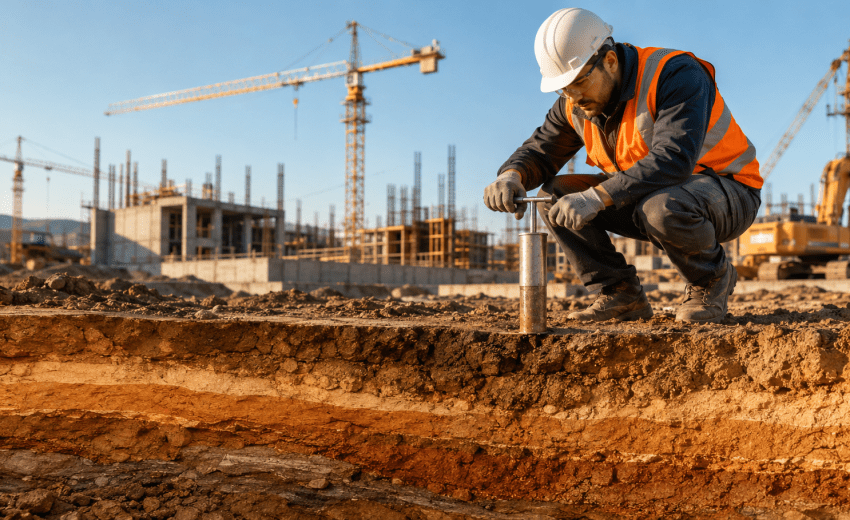
Soil Testing is one of the most critical — yet frequently overlooked — steps before any Construction project breaks ground. During a professional geotechnical assessment, a certified specialist does not simply look for visible surface issues — they evaluate an entire site through a methodical, expert lens, identifying subsurface conditions, structural vulnerabilities, and early indicators of ground instability that would go completely unnoticed by an untrained eye.
Every property assessment carried out by our certified geotechnical specialists brings deep knowledge of local soil profiles, environmental conditions, and the specific vulnerabilities created by regional climate and Construction styles. Understanding what happens during a professional evaluation helps developers and homeowners appreciate the genuine value of expert assessment — and why it is so much more powerful than a surface-level site visit.
Why a Professional Soil Assessment Is Different
Many developers assume a professional Soil Testing programme simply involves collecting a few samples and confirming the ground is firm. In reality, a thorough geotechnical evaluation is a comprehensive structural and environmental review.
Certified specialists are trained to think like the forces that will act on a building — understanding how loads transfer through soil, where failure planes are likely to form, what conditions drive settlement or subsidence, and what the earliest signs of ground instability look like before a Construction project is compromised. A skilled assessment identifies not just current conditions but the factors that make future risk likely — giving project teams the opportunity to act before a minor concern becomes a major structural failure.
1. Entry Points and Structural Vulnerabilities
The first thing our certified specialists assess is how ground conditions — and the weaknesses within them — could affect the structural integrity of the proposed build. This is far more detailed than confirming the site appears level.
A professional Soil Testing evaluation covers:
- Sub-surface voids and cavities — even small underground voids can cause differential settlement, particularly in areas with limestone bedrock or historical landfill.
- Soil stratification and layer transitions — changes between load-bearing and weak soil layers at depth are critical to foundation design decisions.
- Groundwater table depth and fluctuation — seasonal or permanent high water tables affect both foundation design and long-term structural durability.
- Expansive or shrink-swell clay layers — highly relevant in many regional soils where seasonal moisture changes cause significant ground movement.
- Legacy contamination zones — industrial or reclaimed land sites may conceal buried material that compromises Construction viability and regulatory compliance.
Identifying and addressing these vulnerabilities at the assessment stage is often far more important than any remedial measure applied after Construction begins.
2. Signs of Ground Instability and Risk
Once the site profile is assessed, our specialists move through the geotechnical data systematically, looking for evidence of conditions that present risk to the proposed structure:
- Settlement potential indicators — compressibility testing identifies layers likely to compress under structural load over time.
- Shear strength deficiencies — low shear strength in saturated soils is a primary driver of foundation failure and slope instability.
- Loose or poorly compacted fill — frequently identified on previously developed sites and a major risk factor for uneven settlement.
- Lateral movement risk — assessed through slope stability analysis on any site with gradient or proximity to excavated faces.
- Bearing capacity insufficiency — direct measurement of how much load the ground can sustainably carry beneath proposed foundation positions.
Seismic vulnerability — liquefaction potential assessment in areas with seismic exposure, where saturated loose sands can behave like liquid under dynamic loading.
3. Environmental and Moisture Conditions
Regional climate makes moisture management one of the most critical factors in any Soil Testing programme. Many of the most common ground failure mechanisms — including heave, settlement, and piping — are driven primarily by water movement through soil rather than load alone.
During an assessment, our certified team evaluates:
- Permeability and drainage characteristics — determining how quickly water moves through soil layers and where it accumulates under the proposed structure.
- Capillary rise potential — in fine-grained soils, moisture can rise significantly above the water table and affect foundation elements not designed for wet conditions.
- Sulphate and chloride content — aggressive ground chemistry degrades concrete and steel reinforcement, requiring specific material specifications in the Construction programme.
- Seasonal moisture variation depth — understanding how deep seasonal changes penetrate informs the minimum foundation depth required for long-term stability.
Addressing moisture-related ground conditions is frequently the single most impactful long-term protection measure a Construction project can implement.
4. Soil Composition and Load-Bearing Capacity
Beyond moisture, the fundamental composition of the ground is the primary determinant of what can safely be built and how. Our certified professionals are trained to identify the conditions that govern structural performance:
- Particle size distribution — gravel, sand, silt, and clay each behave differently under load, and the proportion of each directly affects foundation design.
- Organic content — soils with significant organic material are highly compressible and generally unsuitable as bearing strata without treatment.
- Relative density and compaction state — loose granular soils require either deep foundations or ground improvement before Construction can safely proceed.
- Rock head depth and quality — where rock is present, confirming its depth, continuity, and strength is essential for piled foundation design.
5. Previous Site History and Treatment Records
An important but frequently overlooked element of a thorough Soil Testing programme is the history of any previous activity on the site. Our team reviews available records and looks for physical evidence of prior Construction, demolition, filling, or contamination — assessing whether ground conditions have been adequately characterised by earlier investigations.
This history directly informs the most appropriate current testing strategy and identifies whether any legacy conditions — buried structures, contaminated zones, poorly documented fill — need to be specifically addressed in the geotechnical programme.
6. Risk Rating and Recommendations
At the conclusion of every assessment, our geotechnical specialists compile findings into a clear risk report covering:
- Active ground conditions requiring immediate design response.
- High-risk factors needing remediation or treatment before Construction begins.
- Moderate observations to monitor throughout the Construction programme.
- Recommended foundation strategy — including foundation type, bearing depth, and any ground improvement requirements.
Every recommendation is explained in full, giving developers, architects, and engineers complete understanding of what has been found, what it means, and what the most effective Construction response looks like.
Conclusion
A professional Soil Testing programme is far more than a regulatory formality. It is a skilled, systematic evaluation of the ground beneath your entire project — identifying active risks, hidden vulnerabilities, and environmental conditions that place your Construction investment at risk. Our certified geotechnical specialists bring the knowledge, experience, and technical rigour to deliver assessments that genuinely protect projects — not just at the point of build but for the full life of the structure ahead.
Contact us today to book your complimentary consultation and take the first step toward a fully informed, safely founded Construction project.
Ready to Build with Confidence?
Get in touch with Charminar to learn how our project management expertise can streamline your next development.
📧 contact@bluediamondfm.com
📞 +971 56 705 4223
🌐 https://charminardubai.com/
Frequently Asked Questions (FAQ)
How long does a professional Soil Testing programme take?
For a standard residential plot, a thorough Soil Testing assessment — including site investigation, laboratory analysis, and report preparation — typically takes between 5 and 15 business days depending on the size and complexity of the site. Large commercial or infrastructure projects with multiple investigation points may require an extended programme.
Do I need to prepare my site before a geotechnical assessment?
No major preparation is required. However, providing access to all areas of the site — including any existing structures, basements, or previously developed zones — allows our certified team to conduct the most comprehensive evaluation possible. Sharing any existing drawings, previous reports, or utility records also helps the assessment process significantly.
What happens if Soil Testing reveals poor ground conditions?
If our evaluation identifies unsuitable bearing conditions, our certified specialist will explain the findings clearly and recommend an appropriate ground improvement or foundation strategy. In most cases, even challenging ground conditions can be effectively managed when identified early — the key is knowing before Construction begins, not after.
Is Soil Testing only necessary for large commercial projects?
Not at all. A proactive geotechnical assessment is one of the most valuable steps any developer or homeowner can take — regardless of project scale. Many costly foundation problems discovered in residential Construction could have been prevented with a straightforward Soil Testing programme conducted at the planning stage.
Can your team detect problems if there are no visible signs at the surface?
Yes. Our certified specialists are equipped to detect sub-surface conditions well before any surface evidence develops — assessing soil layering, moisture conditions, bearing capacity, and chemical aggression through targeted sampling and laboratory analysis. Early detection dramatically reduces the cost and complexity of any remedial response required.